


New 'electronic glue' promises less expensive semiconductors
Related images
(click to enlarge)
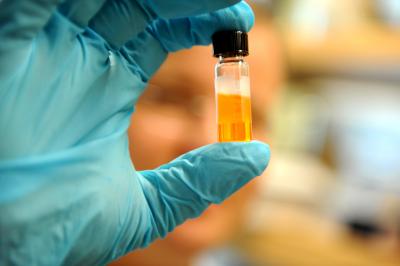
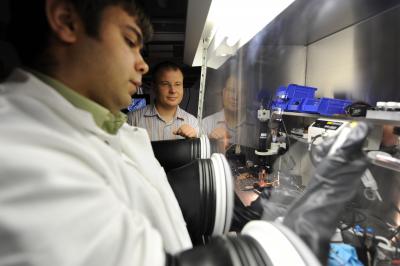

Researchers at the University of Chicago and Lawrence Berkeley National Laboratory have developed an "electronic glue" that could accelerate advances in semiconductor-based technologies, including solar cells and thermoelectric devices that convert sun light and waste heat, respectively, into useful electrical energy. Semiconductors have served as choice materials for many electronic and optical devices because of their physical properties. Commercial solar cells, computer chips and other semiconductor technologies typically use large semiconductor crystals. But that is expensive and can make large-scale applications such as rooftop solar-energy collectors prohibitive.
For those uses, engineers see great potential in semiconductor nanocrystals, sometimes just a few hundred atoms each. Nanocrystals can be readily mass-produced and used for device manufacturing via inkjet printing and other solution-based processes. But a problem remains: The crystals are unable to efficiently transfer their electric charges to one another due to surface ligands—bulky, insulating organic molecules that cap nanocrystals.
The "electronic glue" developed in Dmitri Talapin's laboratory at the University of Chicago solves the ligand problem. The team describes in the journal Science how substituting the insulating organic molecules with novel inorganic molecules dramatically increases the electronic coupling between nanocrystals. The University of Chicago licensed the underlying technology for thermoelectric applications to Evident Technologies in February.
Source: University of Chicago
Other sources
- New 'Electronic Glue' Promises Cheaper Semiconductorsfrom Newswise - ScinewsThu, 11 Jun 2009, 22:49:12 UTC
- New 'Electronic Glue' Promises Less Expensive Semiconductorsfrom Science DailyThu, 11 Jun 2009, 19:28:10 UTC
- New 'electronic glue' promises less expensive semiconductorsfrom PhysorgThu, 11 Jun 2009, 18:42:14 UTC
- New 'Electronic Glue' Promises Cheaper Semiconductorsfrom Newswise - ScinewsThu, 11 Jun 2009, 18:42:06 UTC