


Refining a cosmic clock
Related images
(click to enlarge)
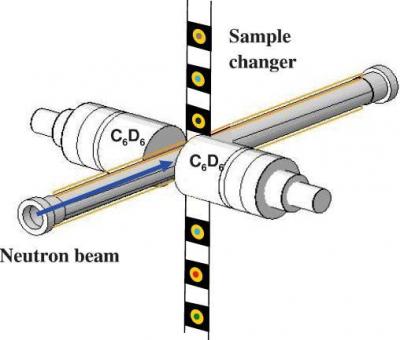
Physicists will soon have a better measure of the age of our galaxy, thanks to experiments described in a trio of papers appearing in the journal Physical Review C. The papers report on experiments at the CERN neutron time-of-flight (n_TOF) facility and the Karlsruhe Van de Graaff accelerator that clarify the processes that affect the abundance of the element osmium-187. The element is created when rhenium-187 decays. Because rhenium-187 was produced in the first stellar explosions after the birth of the galaxy, measuring the amounts of rhenium-187 and osmium-187 we observe today can provide an estimate of the galaxy's age. In effect, the elements act as a cosmic clock that started ticking when the galaxy was born. Unfortunately, there are various processes that can affect the amounts of osmium we measure. Uncertainties in our understanding of those processes have limited the accuracy of the cosmic clock to more than a billion years. The CERN and Karlsruhe experiments involve firing pulses of neutrons into an osmium target to determine how frequently the element is likely to capture neutrons and convert to another material. The data the researchers collected has reduced uncertainties in the rhenium-osmium cosmic clock to less than a billion years, allowing a better estimate of our roughly 14 billion year old galaxy.
Source: American Physical Society
Other sources
- Refining a cosmic clockfrom PhysorgThu, 15 Jul 2010, 21:49:13 UTC