


NASA sees Tropical Storm Javier form in the Eastern Pacific
Related images
(click to enlarge)

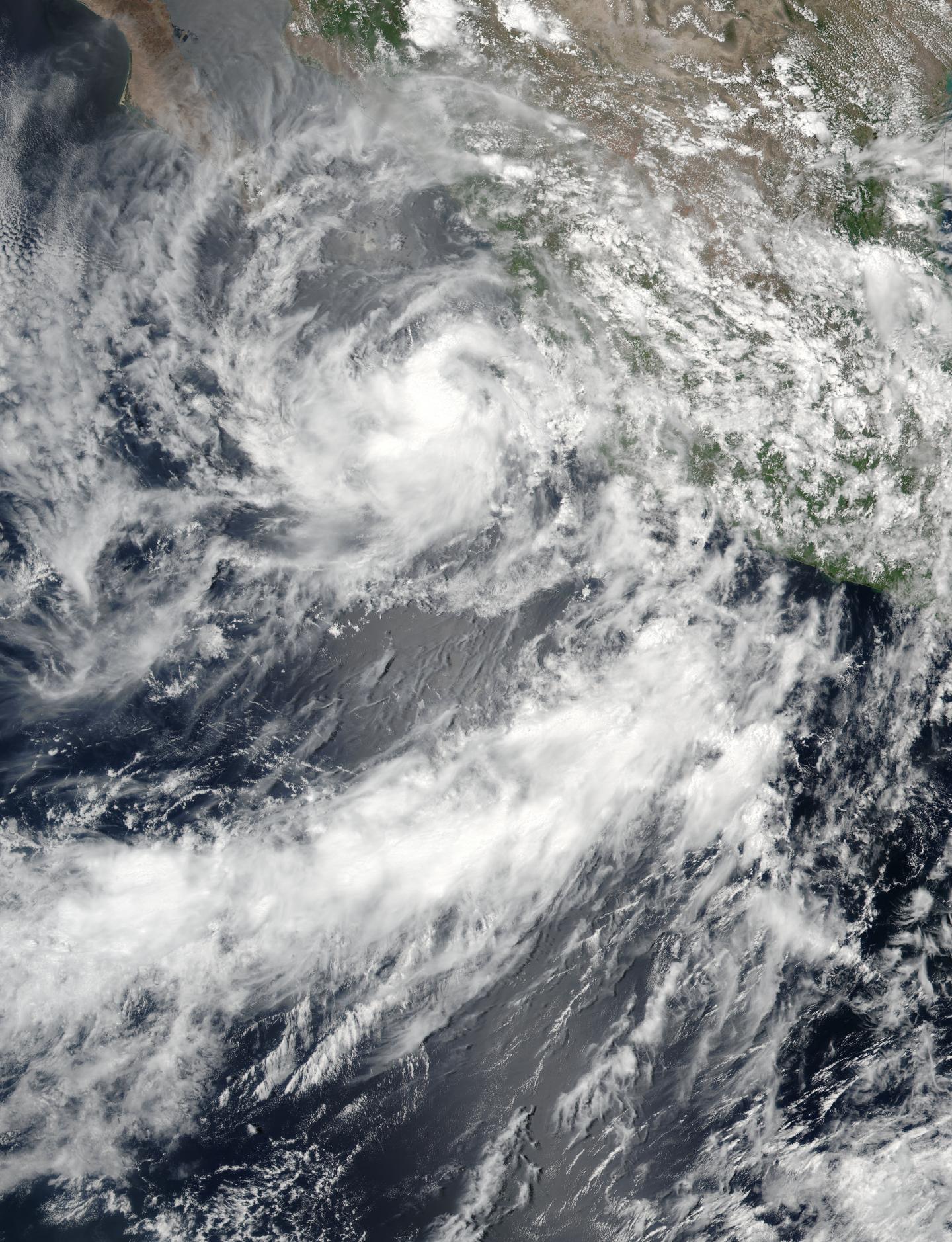
Tropical Storm Javier formed on Aug. 7, 2016 in the Eastern Pacific Ocean off Mexico's western coast. Javier formed partially from the remnants of Hurricane Earl. NASA's Global Precipitation Measurement core satellite found that Javier contained heavy rain. On Aug. 8, Javier triggered hurricane and tropical storm warnings. Landslides caused by heavy rainfall from the remnants of Hurricane Earl caused the reported deaths of at least 39 people in eastern Mexico. That kind of rainfall was now seen in Tropical Storm Javier.
The Global Precipitation Measurement mission, or GPM core observatory satellite, flew above Tropical Storm Javier on Aug. 8, 2016 at 12:19 a.m. EDT (0419 UTC). Rainfall was analyzed using GPM's Microwave Imager (GMI) and Dual-Frequency Precipitation Radar (DPR) instruments. Those data showed that Javier was producing heavy rainfall both near the center of the tropical storm and also near Mexico's coast northeast of Javier. Rain was measured by DPR falling at a rate of over 4.1 inches (103 mm) per hour near Javier's center of circulation. Precipitation was also calculated by GPM's GMI to be coming down at a rate of almost 2.4 inches (60 mm) per hour near Mazatlán, Mexico.
The National Hurricane Center expects that heavy rainfall to affect warning areas. Javier is expected to produce total rain accumulations of 3 to 6 inches over coastal parts of the Mexican states of Sinaloa and southern Sonora into Baja California Sur with possible isolated maximum amounts of 10 inches through Wednesday morning.
GPM's Radar (DPR Ku band) found that storm tops' heights were highest near Mexico's coast. Three-dimensional measurements of precipitation near Javier's center showed storm tops were above 8.1 miles (13 km) while tall storms near Mexico's coast reached altitudes above 10.5 miles (17 km). GPM is a joint mission between NASA and the Japanese space agency JAXA.
On Aug. 8, the National Hurricane Center posted a hurricane warning from Los Barriles to Todos Santos, Mexico. A hurricane watch is in effect from Todos Santos to Cabo San Lazaro. In addition, a tropical storm warning is in effect for Los Barriles to San Evaristo and Todos Santos to Cabo San Lazaro. A tropical storm watch is in effect for San Evaristo to Loreto Cabo San Lazaro to Puerto San Andresito.
At 11 a.m. EDT (1500 UTC), the center of Tropical Storm Javier was located near 22.0 degrees north and 109.2 degrees west longitude. That's about 75 miles (125 km) southeast of Cabo San Lucas, Mexico. Javier is moving toward the northwest near 10 mph (17 kph), and this motion with a decrease in forward speed is expected through Tuesday. On the forecast track, the center of Javier is forecast to pass near or over the southern tip of the Baja California peninsula later today, and move near the west coast of Baja California Sur tonight and Tuesday. Maximum sustained winds are near 50 mph (85 kph) with higher gusts. Some strengthening is possible while Javier passes near the extreme Baja California peninsula.
For updated forecasts, visit the NHC website: http://www.nhc.noaa.gov
Source: NASA/Goddard Space Flight Center
Articles on the same topic
- NASA sees wind shear relax in Tropical Storm ConsonFri, 12 Aug 2016, 19:04:05 UTC
- NASA measures winds of Tropical Storm ConsonThu, 11 Aug 2016, 19:52:53 UTC
- NASA sees wind shear relax in Tropical Storm ConsonWed, 10 Aug 2016, 15:05:08 UTC
- Satellite sees remnants of Tropical Depression JavierWed, 10 Aug 2016, 14:34:27 UTC
- NASA spots Tropical Storm Javier at southern tip of Baja CaliforniaTue, 9 Aug 2016, 19:04:13 UTC
- NASA measures winds of Tropical Storm OmaisTue, 9 Aug 2016, 19:04:00 UTC
- NASA spots Tropical Storm Conson facing wind shearTue, 9 Aug 2016, 16:03:20 UTC
- NASA sees Tropical Storm Omais weakening near JapanMon, 8 Aug 2016, 20:03:25 UTC
- NASA gets an infrared look at newly formed Tropical Depression 08WMon, 8 Aug 2016, 19:03:26 UTC
- NASA infrared imagery shows Tropical Depression Ivette weakeningMon, 8 Aug 2016, 17:34:25 UTC
- NASA sees Tropical Storm Omais in infrared lightFri, 5 Aug 2016, 18:04:54 UTC
- NASA's Terra satellite sees Tropical Storm Ivette holding steadyFri, 5 Aug 2016, 16:36:27 UTC
- Satellite spots new Tropical Storm Ivette far from Baja CaliforniaFri, 5 Aug 2016, 16:36:16 UTC
- NASA sees Tropical Storm Omais form in Northwestern PacificThu, 4 Aug 2016, 17:53:39 UTC
- NASA sees tropical storm Howard weakeningWed, 3 Aug 2016, 16:10:29 UTC
- NASA catches visible and infrared views of Tropical Storm HowardTue, 2 Aug 2016, 16:35:33 UTC
- NASA spots Tropical Storm Howard developing in Eastern PacificMon, 1 Aug 2016, 17:33:27 UTC
- NASA infrared imagery shows new tropical depression coming togetherMon, 1 Aug 2016, 17:33:04 UTC
- NASA finds Tropical Cyclone Frank fadingMon, 1 Aug 2016, 17:32:54 UTC
Other sources
- NASA measures winds of Tropical Storm Consonfrom PhysorgThu, 11 Aug 2016, 20:11:13 UTC
- NASA sees wind shear relax in Tropical Storm Consonfrom PhysorgWed, 10 Aug 2016, 15:01:30 UTC
- NASA spots Tropical Storm Javier at southern tip of Baja Californiafrom PhysorgTue, 9 Aug 2016, 19:51:26 UTC
- NASA measures winds of Tropical Storm Omaisfrom PhysorgTue, 9 Aug 2016, 19:21:14 UTC
- NASA spots Tropical Storm Conson facing wind shearfrom PhysorgTue, 9 Aug 2016, 16:21:14 UTC
- NASA sees Tropical Storm Omais weakening near Japanfrom PhysorgMon, 8 Aug 2016, 20:01:34 UTC
- NASA gets an infrared look at newly formed Tropical Depression 08Wfrom PhysorgMon, 8 Aug 2016, 19:31:37 UTC
- NASA sees Tropical Storm Javier form in the Eastern Pacificfrom PhysorgMon, 8 Aug 2016, 19:01:29 UTC
- NASA infrared imagery shows Tropical Depression Ivette weakeningfrom PhysorgMon, 8 Aug 2016, 18:02:15 UTC
- NASA sees Tropical Storm Omais in infrared lightfrom PhysorgFri, 5 Aug 2016, 18:31:32 UTC
- Terra satellite sees Tropical Storm Ivette holding steadyfrom PhysorgFri, 5 Aug 2016, 18:01:28 UTC
- NASA sees Tropical Storm Omais form in Northwestern Pacificfrom PhysorgThu, 4 Aug 2016, 18:01:10 UTC
- NASA sees tropical storm Howard weakeningfrom PhysorgWed, 3 Aug 2016, 20:31:42 UTC
- Satellite spots new Tropical Storm Ivette far from Baja Californiafrom PhysorgWed, 3 Aug 2016, 19:31:37 UTC
- NASA catches visible and infrared views of Tropical Storm Howardfrom PhysorgTue, 2 Aug 2016, 17:01:32 UTC
- NASA spots Tropical Storm Howard developing in Eastern Pacificfrom PhysorgMon, 1 Aug 2016, 17:31:29 UTC
- NASA infrared imagery shows new tropical depression coming togetherfrom PhysorgFri, 29 Jul 2016, 19:01:18 UTC
- NASA finds Tropical Cyclone Frank fadingfrom PhysorgThu, 28 Jul 2016, 17:01:30 UTC